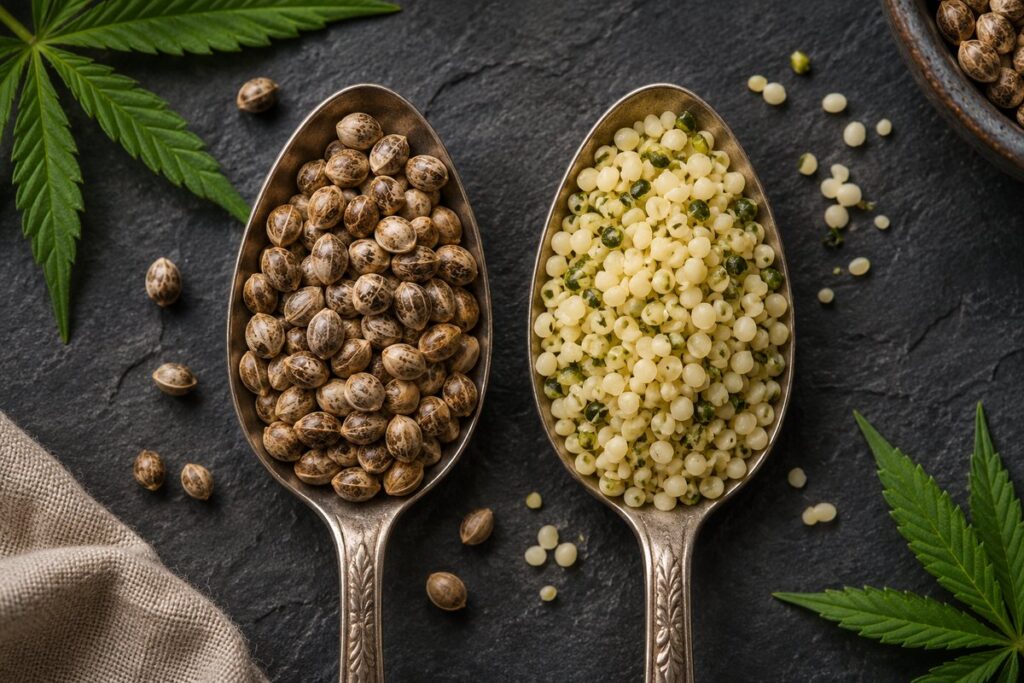
Set two bowls on a kitchen scale. Fill one with whole hemp seeds and the other with the little cream-colored kernels sold as hemp hearts. Adjust them to exactly the same weight. The second bowl is likely to contain more protein and oil, the first more fiber. Nothing nutritious had to be added to the hearts for that difference to appear. Someone simply removed part of each seed before it reached the scale.
That small act of subtraction complicates a familiar phrase in food science: “higher in protein.” It can refer to a greater concentration in a spoonful, more protein recovered from an entire harvest, or a better supply of particular amino acids. One comparison of whole and hulled seeds puts real numbers on the first of those meanings.
What the laboratory weighed
In a study comparing whole, hulled and germinated hemp seeds, whole seeds contained about 25 grams of crude protein per 100 grams of dry matter. The dehulled samples contained about 34. The corresponding figures for the oil-rich fraction measured by solvent extraction were roughly 31 and 48 grams. Crude fiber went the other way, from about 25 grams in the whole seeds to 8 in the hulled material.
“Dry matter” belongs beside each of those numbers. Water counts on a kitchen scale even though it contributes no protein. Laboratory values expressed per hundred grams of dry matter remove the variability introduced by samples with different water contents. They allow an orderly comparison of solids. A label on a retail bag describes the food and serving as sold, so its figures need not match the laboratory table exactly.
The word “crude” has a technical meaning, too. In this experiment, researchers estimated crude protein from the amount of nitrogen in a sample using a conversion factor. Crude fiber is also a laboratory measurement, obtained by a specified chemical procedure. It is sensible to compare samples tested by the same method. Substituting that crude fiber result for the dietary fiber on every nutrition label would be a different calculation.
Count the seeds instead
Now give up the rule about equal bowl weights. Take a hundred whole seeds, shell them and keep both piles. The kernels retain much of the original oil and protein. Some material also leaves with the hulls. You cannot have created more protein by shelling those hundred seeds, even though the percentage in the pile of kernels has gone up.
A review of hempseed nutrition describes the way the oil-rich kernel and fibrous exterior contribute differently to the composition of hemp foods. That anatomy explains why the kitchen-scale experiment and the seed-counting experiment give different impressions. To fill the original bowl back to its original weight with hearts alone, you have to shell additional seeds. An independent comparison of whole and dehulled hempseed offers another look at how composition varies between the two forms.
Grams of protein answer only one question
Researchers have also tested the protein quality of Canadian hempseed products. Such work considers which indispensable amino acids a protein supplies, along with how readily the protein can be digested. A high protein concentration does not automatically give a high score on that separate assessment. Nor does it tell us how much of any one amino acid a person gets from an ordinary serving in a mixed meal.
In a recipe, there are good reasons to care about the original distinction. A handful of kernels scattered over porridge contributes a soft, oil-rich ingredient. Leaving the hull in place changes the texture and the material available for fiber measurements. Equal volumes can also weigh differently, so a tablespoon is a less exact comparison than a scale. The useful question to take back to the kitchen is wonderfully literal: are you comparing the same weight of food, the same number of seeds or the portion you actually intend to eat?